Master's HCI Capstone
Master's HCI Capstone
Can soundscapes help video game players regulate emotion?
Can soundscapes help video game players regulate emotion?
Summary
Summary
A mixed-method HCI study on how soundscapes influence control, focus, and gameplay performance
A mixed-method HCI study on how soundscapes influence control, focus, and gameplay performance
Roles
Roles
Research design, recruitment, facilitation, quantitative analysis, thematic analysis, and design synthesis
Research design, recruitment, facilitation, quantitative analysis, thematic analysis, and design synthesis
Worked under
Worked under
Prof. Roshan Peiris
Prof. Carlos Castellanos
Prof. Roshan Peiris
Prof. Carlos Castellanos

TL;DR
TL;DR
For my Master's HCI capstone, I explored whether soundscapes could help players regulate those emotions during difficult gameplay - and whether feeling more balanced could improve performance.
I expected tempo to be the main variable. The research revealed a more useful story: moderate-tempo audio produced the strongest observed control and performance, but personal taste and fit with the game determined whether any soundscape actually helped.
For my Master's HCI capstone, I explored whether soundscapes could help players regulate those emotions during difficult gameplay - and whether feeling more balanced could improve performance.
I expected tempo to be the main variable. The research revealed a more useful story: moderate-tempo audio produced the strongest observed control and performance, but personal taste and fit with the game determined whether any soundscape actually helped.
Moderate soundscapes
was found to improved control and performance
Moderate soundscapes
was found to improved control and performance
Key statistical result:
Sound condition had a significant overall effect on perceived control (p = .03, eta-squared = .21) and completion time (p = .049, eta-squared = .21).
Key statistical result:
Sound condition had a significant overall effect on perceived control (p = .03, eta-squared = .21) and completion time (p = .049, eta-squared = .21).
Key statistical result:
Sound condition had a significant overall effect on perceived control (p = .03, eta-squared = .21) and completion time (p = .049, eta-squared = .21).
The opportunity
The opportunity
Many people play games to relax, yet games rarely help players regulate the emotions they create. Difficulty systems may adapt challenge, but audio is usually treated as atmosphere rather than as an active part of player wellbeing.
Many people play games to relax, yet games rarely help players regulate the emotions they create. Difficulty systems may adapt challenge, but audio is usually treated as atmosphere rather than as an active part of player wellbeing.

Help players regulate emotion.
Improve gameplay performance.
Help players regulate emotion.
Improve gameplay performance.
The goal was not simply to find the most pleasant track. It was to understand how audio changes the relationship between stress, control, immersion, and performance.
The goal was not simply to find the most pleasant track. It was to understand how audio changes the relationship between stress, control, immersion, and performance.
Context before generation
Context before generation
A two-phase study
A two-phase study
Phase 1: Choosing balanced soundscapes
Phase 1: Choosing balanced soundscapes
I first asked 45 participants to rate nine soundscapes in an online Qualtrics survey. The tracks were grouped into three tempo ranges:
Slow: approximately 90-110 BPM
Moderate: approximately 120 BPM
Fast: approximately 140 BPM or higher
I first asked 45 participants to rate nine soundscapes in an online Qualtrics survey. The tracks were grouped into three tempo ranges:
Slow: approximately 90-110 BPM
Moderate: approximately 120 BPM
Fast: approximately 140 BPM or higher
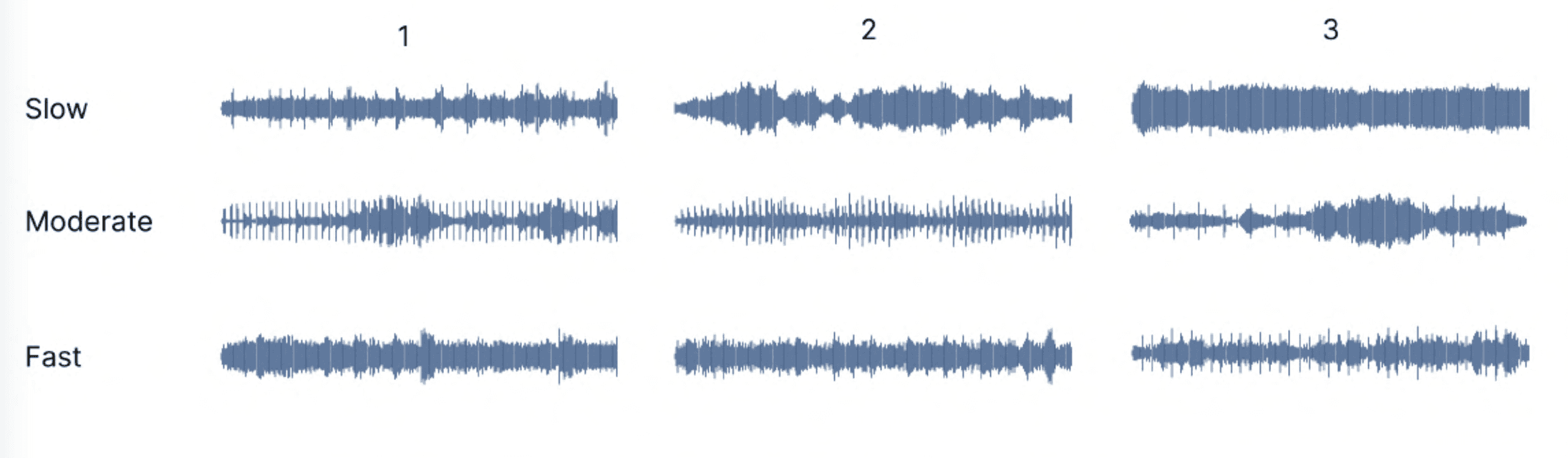
Participants rated each soundscape from 0 to 10 for pleasantness. I selected the top-rated example from each group for the gameplay study:
Participants rated each soundscape from 0 to 10 for pleasantness. I selected the top-rated example from each group for the gameplay study:

This reduced a potential confound: Phase 2 would compare three reasonably pleasant tracks rather than one appealing track against tracks participants already disliked.
This reduced a potential confound: Phase 2 would compare three reasonably pleasant tracks rather than one appealing track against tracks participants already disliked.
Phase 2: Testing during gameplay
Phase 2: Testing during gameplay

Twelve participants played Clustertruck, a fast-paced platform game, under four conditions:
No sound
Slow-tempo soundscape
Moderate-tempo soundscape
Fast-tempo soundscape
Twelve participants played Clustertruck, a fast-paced platform game, under four conditions:
No sound
Slow-tempo soundscape
Moderate-tempo soundscape
Fast-tempo soundscape
Gameplay screenshots from the used game Clustertruck
Gameplay screenshots from the used game Clustertruck
Gameplay screenshots from the used game Clustertruck


Every participant experienced all four conditions. Sound order was randomized, each session lasted five minutes, and the study took place in a controlled lab environment.
Every participant experienced all four conditions. Sound order was randomized, each session lasted five minutes, and the study took place in a controlled lab environment.
After each condition, participants rated:
Valence: how pleasant the experience felt
Arousal: how calm or activated they felt
Dominance: how much control they felt
After each condition, participants rated:
Valence: how pleasant the experience felt
Arousal: how calm or activated they felt
Dominance: how much control they felt

I also recorded completion time and collected post-session reflections and interviews. The emotional ratings and performance data showed what changed; the interviews helped explain why.
I also recorded completion time and collected post-session reflections and interviews. The emotional ratings and performance data showed what changed; the interviews helped explain why.
Moderate tempo created the strongest balance
Moderate tempo created the strongest balance
Valence remained stable across conditions. Arousal showed a trend toward balanced activation in the moderate condition, but the overall effect did not meet the conventional significance threshold.
The clearest differences appeared in control and performance:
Valence remained stable across conditions. Arousal showed a trend toward balanced activation in the moderate condition, but the overall effect did not meet the conventional significance threshold.
The clearest differences appeared in control and performance:

Moderate-tempo audio appeared to sit between two extremes. It offered more activation than the slow condition without creating the intensity some participants felt during faster audio.
Moderate-tempo audio appeared to sit between two extremes. It offered more activation than the slow condition without creating the intensity some participants felt during faster audio.
But the averages did not tell the whole story.
But the averages did not tell the whole story.
The interviews changed the interpretation
The quantitative results suggested a moderate-tempo advantage. The interviews showed why no single tempo could work for everyone.
Insight 1
Silence was stressful, not neutral
The no-sound condition was consistently described as the most negative. Without background audio, participants reported greater irritation, stress, and difficulty concentrating.
"I was not able to concentrate on the game, because there was no background sound or noise." - P12
Insight 2
Calm could become disconnection
Slow, nature-oriented soundscapes often reduced stress. However, when the sound did not match the pace of the game, some participants felt detached or less motivated to perform.
"The music was also calm, but I just feel like it didn't fit the vibe of the game." - P06
Insight 3
Matching the pace supported flow
Faster soundscapes sometimes increased nervousness. When the pacing felt aligned with the game, however, they could increase confidence, motivation, and immersion.
"It meshed well with the gameplay... the pacing made sense for the game." - P11
Insight 4
Familiarity could override tempo
Personal taste was the strongest mediator. Nature sounds intended to be calming distracted some participants. A fast track felt calming to someone who recognized it as a familiar lo-fi style.
"I felt like I was way more focused... I am used to listening to this kind of lo-fi beats while I'm working."
- P06
The turning point: variation was part of the finding
The emotional ratings showed limited group-level differences, while interviews revealed strong and polarized reactions. This initially looked like a mismatch.
It was actually the central insight.
Quantitative data showed the average direction of each condition.
Interviews explained why those averages varied so widely.
Performance data showed that moderate tempo still offered a measurable overall advantage.

The study began as a search for an effective tempo. It ended by showing why emotional audio should be personalized.
Impact
The project reframed sound from an atmospheric layer into a possible emotional-regulation tool.
It showed that:
Result 1
Sound condition can affect perceived control and gameplay performance.
Result 2
Silence can actively increase stress during difficult gameplay.
Result 3
Moderate tempo offered the strongest observed balance across participants.
Result 4
Personal preference and game fit explain why universal audio interventions break down.
The result is not a claim that moderate tempo works for every player. The stronger contribution is a design direction: combine a useful default with player-controlled personalization.
Limitations and next steps
The experimental study used 12 participants, one game genre, short five-minute sessions, and self-reported emotion. Tempo was also bundled with genre and sound texture, making it difficult to isolate each factor completely.
Next, I would:
Test a working personalization feature across several game genres.
Separate tempo, familiarity, genre, and texture as variables.
Run longer diary or longitudinal studies.
Add physiological measures such as heart rate or skin conductance.
Explore sensory sensitivity and neurodivergent player needs.
The interviews changed the interpretation
The quantitative results suggested a moderate-tempo advantage. The interviews showed why no single tempo could work for everyone.
Insight 1
Silence was stressful, not neutral
The no-sound condition was consistently described as the most negative. Without background audio, participants reported greater irritation, stress, and difficulty concentrating.
"I was not able to concentrate on the game, because there was no background sound or noise." - P12
Insight 2
Calm could become disconnection
Slow, nature-oriented soundscapes often reduced stress. However, when the sound did not match the pace of the game, some participants felt detached or less motivated to perform.
"The music was also calm, but I just feel like it didn't fit the vibe of the game." - P06
Insight 3
Matching the pace supported flow
Faster soundscapes sometimes increased nervousness. When the pacing felt aligned with the game, however, they could increase confidence, motivation, and immersion.
"It meshed well with the gameplay... the pacing made sense for the game." - P11
Insight 4
Familiarity could override tempo
Personal taste was the strongest mediator. Nature sounds intended to be calming distracted some participants. A fast track felt calming to someone who recognized it as a familiar lo-fi style.
"I felt like I was way more focused... I am used to listening to this kind of lo-fi beats while I'm working."
- P06
The turning point: variation was part of the finding
The emotional ratings showed limited group-level differences, while interviews revealed strong and polarized reactions. This initially looked like a mismatch.
It was actually the central insight.
Quantitative data showed the average direction of each condition.
Interviews explained why those averages varied so widely.
Performance data showed that moderate tempo still offered a measurable overall advantage.
The study began as a search for an effective tempo. It ended by showing why emotional audio should be personalized.
Impact
The project reframed sound from an atmospheric layer into a possible emotional-regulation tool.
It showed that:
Result 1
Sound condition can affect perceived control and gameplay performance.
Result 2
Silence can actively increase stress during difficult gameplay.
Result 3
Moderate tempo offered the strongest observed balance across participants.
Result 4
Personal preference and game fit explain why universal audio interventions break down.
The result is not a claim that moderate tempo works for every player. The stronger contribution is a design direction: combine a useful default with player-controlled personalization.
Limitations and next steps
The experimental study used 12 participants, one game genre, short five-minute sessions, and self-reported emotion. Tempo was also bundled with genre and sound texture, making it difficult to isolate each factor completely.
Next, I would:
Test a working personalization feature across several game genres.
Separate tempo, familiarity, genre, and texture as variables.
Run longer diary or longitudinal studies.
Add physiological measures such as heart rate or skin conductance.
Explore sensory sensitivity and neurodivergent player needs.
Reflection
Reflection
I started with a direct question: can tempo regulate emotion during gameplay? The study led to a more meaningful design question: how might games help different players reach the emotional state they need?
The most valuable research lesson came from the apparent mismatch between the numbers and the interviews. Instead of choosing one dataset over the other, I used each to explain the other. That changed the project from a simple tempo comparison into a case for transparent, player-controlled personalization.
Emotionally intelligent systems should not decide how people ought to feel. They should help people reach the state that supports what they are trying to do.
I started with a direct question: can tempo regulate emotion during gameplay? The study led to a more meaningful design question: how might games help different players reach the emotional state they need?
The most valuable research lesson came from the apparent mismatch between the numbers and the interviews. Instead of choosing one dataset over the other, I used each to explain the other. That changed the project from a simple tempo comparison into a case for transparent, player-controlled personalization.
Emotionally intelligent systems should not decide how people ought to feel. They should help people reach the state that supports what they are trying to do.