JuriCloud
JuriCloud
Turning a generic legal-AI experience into an evidence-first research workspace
Turning a generic legal-AI experience into an evidence-first research workspace
I redesigned JuriCloud’s navigation and legal research workflow so AI activity, evidence, citations, and uncertainty were visible and reviewable.
I redesigned JuriCloud’s navigation and legal research workflow so AI activity, evidence, citations, and uncertainty were visible and reviewable.
Roles
Roles
Product Designer
Product Designer
Scope
Scope
Information architecture, conversational AI UX, interaction design, prototyping, design system
Information architecture, conversational AI UX, interaction design, prototyping, design system
Team
Team
2 Developers
1 Product designer - Me
2 Developers
1 Product designer - Me
Company
Company
JuriCloud
JuriCloud
TL;DR
TL;DR
JuriCloud had capable legal-AI infrastructure, but its growing interface made the product difficult to navigate and its research output difficult to inspect. I reorganized the workspace, made AI activity visible, structured answers for review, and designed recovery paths for limited evidence.
JuriCloud had capable legal-AI infrastructure, but its growing interface made the product difficult to navigate and its research output difficult to inspect. I reorganized the workspace, made AI activity visible, structured answers for review, and designed recovery paths for limited evidence.
Context
Context


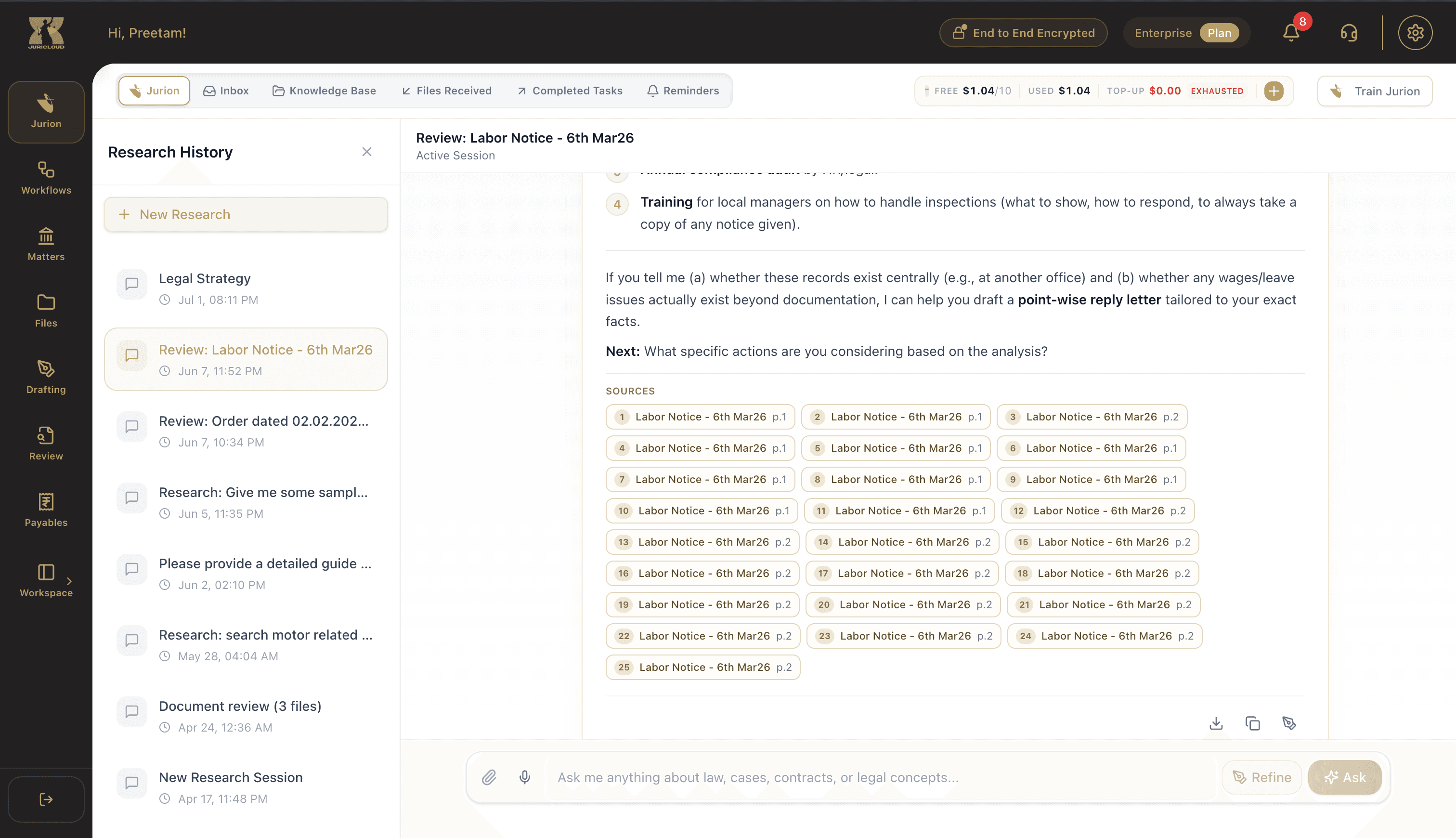

The existing experience created three problems:
The existing experience created three problems:
Navigation did not clearly communicate the platform’s growing set of tools.
Research-agent output was difficult to scan and did not make AI activity visible.
Citations and evidence did not have enough visual importance for professional review.
Navigation did not clearly communicate the platform’s growing set of tools.
Research-agent output was difficult to scan and did not make AI activity visible.
Citations and evidence did not have enough visual importance for professional review.
The design goal was not to make another legal chatbot. It was to make legal-AI research easier to understand, inspect, and verify.
The design goal was not to make another legal chatbot. It was to make legal-AI research easier to understand, inspect, and verify.
Making the product easier to enter
Making the product easier to enter
I grouped a feature-heavy platform into a clearer legal workspace
I grouped a feature-heavy platform into a clearer legal workspace
I started with the navigation because it shaped how people understood the entire product.
I grouped related tools into clearer categories, improved the labels, and introduced more meaningful icons. This made it easier to distinguish research from other legal workflows and gave the platform a clearer product structure.
I started with the navigation because it shaped how people understood the entire product.
I grouped related tools into clearer categories, improved the labels, and introduced more meaningful icons. This made it easier to distinguish research from other legal workflows and gave the platform a clearer product structure.
Decision: prioritize understandable categories over exposing every feature at the same level.
Decision: prioritize understandable categories over exposing every feature at the same level.

Before
Before

After
After
Designing legal research, not generic chat
Designing legal research, not generic chat
AI activity should be visible
AI activity should be visible
Once the product was easier to enter, I focused on the legal research agent.
The original interaction relied too heavily on the familiar prompt-and-response model. In a trust-sensitive workflow, an answer that appears instantly can feel opaque, even when the underlying system is doing meaningful retrieval and research.
Once the product was easier to enter, I focused on the legal research agent.
The original interaction relied too heavily on the familiar prompt-and-response model. In a trust-sensitive workflow, an answer that appears instantly can feel opaque, even when the underlying system is doing meaningful retrieval and research.

To define a better interaction model, I studied AI products including ChatGPT, Claude, Perplexity, and Gemini. I looked at how they handled activity, citations, follow-up questions, and uncertainty, then adapted relevant patterns to the needs of legal research.
To define a better interaction model, I studied AI products including ChatGPT, Claude, Perplexity, and Gemini. I looked at how they handled activity, citations, follow-up questions, and uncertainty, then adapted relevant patterns to the needs of legal research.
I designed observable activity states such as:
I designed observable activity states such as:


These states gave users a legible sense of progress without exposing internal model reasoning.
These states gave users a legible sense of progress without exposing internal model reasoning.
The interface did not need to reveal internal model reasoning. It needed to make the research process understandable enough to review.
The interface did not need to reveal internal model reasoning. It needed to make the research process understandable enough to review.
Evidence and citations
Evidence and citations
I turned dense legal answers into a reviewable format
I turned dense legal answers into a reviewable format
Legal research output can be difficult to scan when everything appears as one long response.
Legal research output can be difficult to scan when everything appears as one long response.
I structured answers into clear sections: Question, background, applicable law, analysis, and practical options.
I structured answers into clear sections: Question, background, applicable law, analysis, and practical options.


This helped readers identify the part of the answer they needed and decide where to inspect further.
This helped readers identify the part of the answer they needed and decide where to inspect further.
Citations needed to remain connected to claims
Citations needed to remain connected to claims
Citations were central to the product’s value, so I designed two complementary evidence patterns:
Inline citation chips connected a claim to its supporting source in context.
A source panel gave users a dedicated place to review cited material without leaving the research flow.
Citations were central to the product’s value, so I designed two complementary evidence patterns:
Inline citation chips connected a claim to its supporting source in context.
A source panel gave users a dedicated place to review cited material without leaving the research flow.
The inline pattern supported fast verification. The source panel supported deeper review.
The inline pattern supported fast verification. The source panel supported deeper review.

Evidence should remain connected to the claim it supports, while still giving users a direct path to inspect the wider source material.
Evidence should remain connected to the claim it supports, while still giving users a direct path to inspect the wider source material.
Uncertainty
Uncertainty
I designed a recovery path for limited evidence
I designed a recovery path for limited evidence
A legal-AI system should not present every answer with the same level of confidence.
For situations where the available sources could not support a firm conclusion, I designed a Limited source support state.
A legal-AI system should not present every answer with the same level of confidence.
For situations where the available sources could not support a firm conclusion, I designed a Limited source support state.

It explained the limitation and gave users two useful next steps:
Review sources to inspect the available evidence.
Refine the question to add context or narrow the scope of research.
It explained the limitation and gave users two useful next steps:
Review sources to inspect the available evidence.
Refine the question to add context or narrow the scope of research.
In legal research, uncertainty is not an error message. It is part of the decision-making workflow.
In legal research, uncertainty is not an error message. It is part of the decision-making workflow.
Design System
The design system supported dynamic AI behavior, dense legal content, and both light and dark themes.

A reusable design system for JuriCloud’s legal AI workflows, covering conversational research, source inspection, matter context, prompt templates, attachments, loading states, citations, and errors.


Components built around conversational workflows.
Components were not created as isolated UI parts. Each component supports a specific AI moment: asking, scoping, attaching, searching, verifying, citing, saving, and recovering from uncertainty.

Design system
I systemized repeated AI behaviors into reusable patterns
As I designed more research scenarios and states, I built a reusable Figma design system around repeated legal-research behaviors.
Components built around conversational workflows.
Components were not created as isolated UI parts. Each component supports a specific AI moment: asking, scoping, attaching, searching, verifying, citing, saving, and recovering from uncertainty.
This made the experience more consistent and gave the team a foundation for future screens.
Extending the system beyond product

Website

Outcome
Outcome
JuriCloud moved from generic chat toward evidence-first research
JuriCloud moved from generic chat toward evidence-first research
The redesign gave the product a clearer point of view: JuriCloud was not just answering legal questions. It was helping professionals conduct research they could inspect and verify.
The redesign gave the product a clearer point of view: JuriCloud was not just answering legal questions. It was helping professionals conduct research they could inspect and verify.
Stakeholder feedback was positive, and the system is continuing to inform additional product screens.
Stakeholder feedback was positive, and the system is continuing to inform additional product screens.
Reflection
Reflection
In legal AI, verification is the product
In legal AI, verification is the product
JuriCloud changed how I think about conversational AI in trust-sensitive domains.
The interface is not simply a wrapper around the model. It is the mechanism that makes AI output understandable, reviewable, and useful in professional work.
JuriCloud changed how I think about conversational AI in trust-sensitive domains.
The interface is not simply a wrapper around the model. It is the mechanism that makes AI output understandable, reviewable, and useful in professional work.
The biggest lesson was that context controls, citations, source inspection, uncertainty states, and recovery paths are not supporting details. In legal AI, they are the product.
The biggest lesson was that context controls, citations, source inspection, uncertainty states, and recovery paths are not supporting details. In legal AI, they are the product.